Two Markets, One System: How Property Managers Win Owners and Fill Homes in 2026
Owners and renters both choose online now. What the data says about how each market decides, what a slow week costs, and what changes when one system runs the marketing for both.
A property manager sells to two markets at once: the owners who hire the company and the renters who fill the homes. Both now decide online, often before anyone at the company knows they are looking. This article reviews what the published data says about how each market chooses, what a slow response costs, and what changes when the marketing for both runs as one system.
Two markets, one reputation
Most service businesses have one customer. A property management company has two, and they rarely meet. Rental owners hire the company to protect an asset and keep it earning. Renters choose a home, and through it, they choose the company that manages it. Each market judges the company by what it can see from a distance, and each one has moved that judgment online.
The owner market is large and fragmented. The most recent federal survey of rental property ownership counted 19.3 million rental properties in the United States, 85.6% of them single-unit, and found that individual investors owned 70.2% of all rental properties (Congressional Research Service, 2022, using the 2021 Rental Housing Finance Survey). Most of the doors a manager could add belong to individuals, one or a few homes at a time.
The renter market is getting harder to fill. The national rental vacancy rate reached 7.6% in the third quarter of 2026, up from 7.1% a year earlier, and the median asking rent for vacant units was $1,541 (U.S. Census Bureau, 2026). More empty units means more competition for each renter, and more weight on how quickly and how well a company answers the ones who inquire.
How owners choose a manager
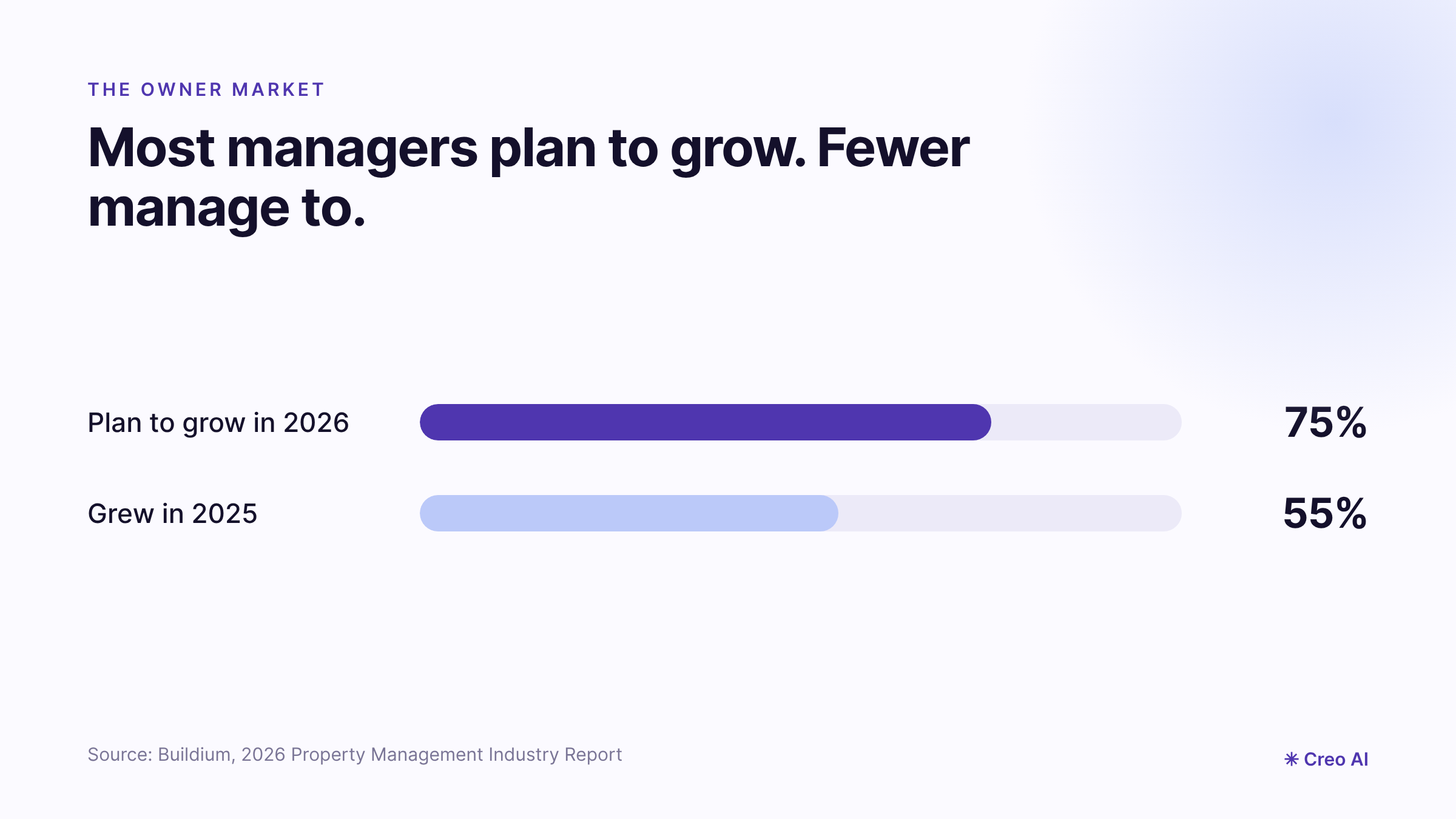
Property managers want to grow, and many are not managing to. In Buildium's 2026 industry report, 75% of companies planned to grow in the coming year, but only 55% had grown in the year before. Referrals from satisfied owners remained the leading source of new business (Buildium, 2026).
A referral now starts a search rather than ending one. Buildium's owner research found that more than one in four rental owners treat a company's website and online reviews as a primary consideration, that 95% want to do business with their manager online, and that 55% do not live in the city where their property is (Buildium, 2024). An owner who lives elsewhere cannot drive by the office. The website, the reviews and the speed of the first reply are the company, as far as that owner can tell.
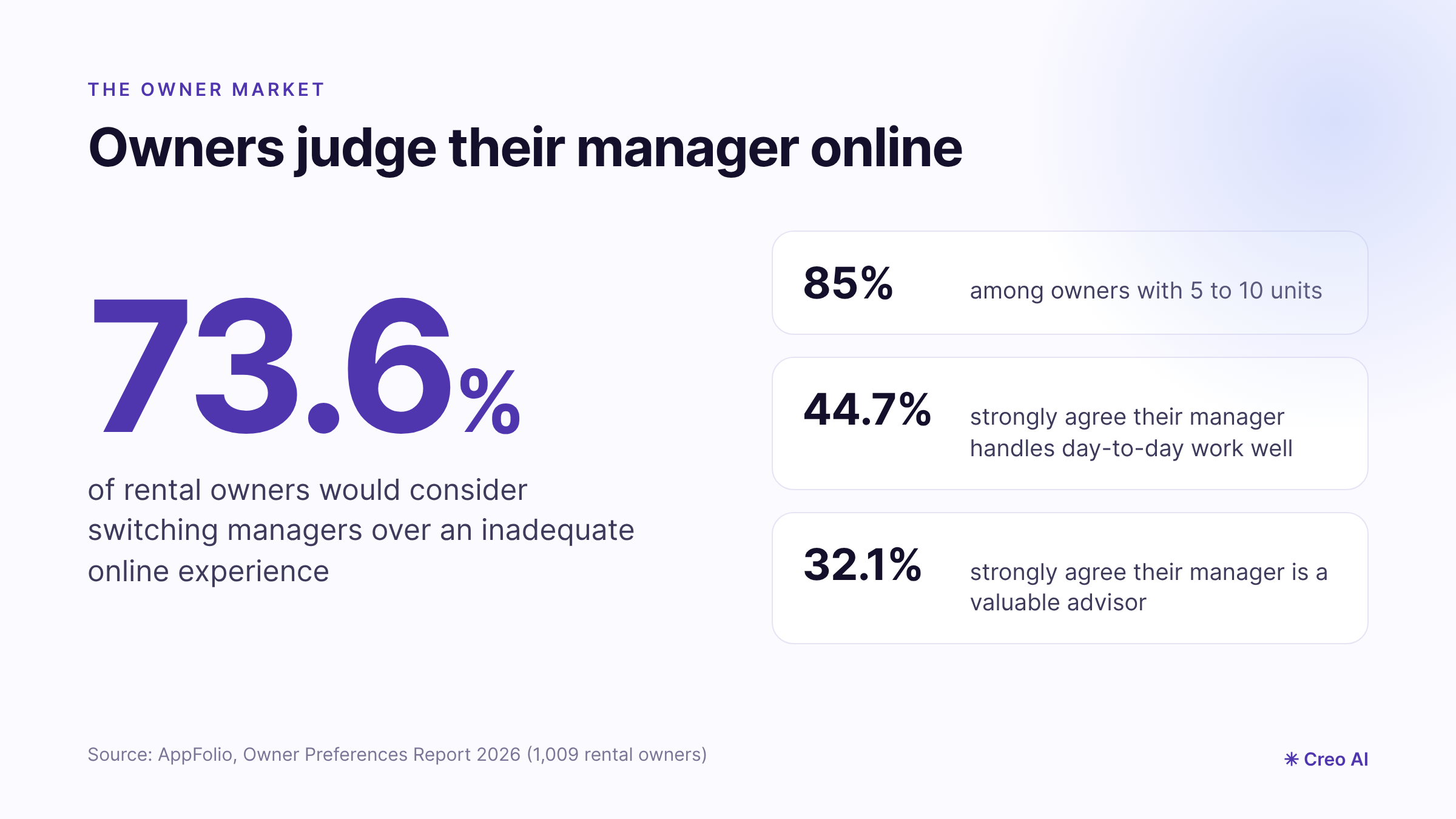
The same holds after an owner signs. AppFolio's 2026 survey of 1,009 rental owners who use a professional manager found that 73.6% would consider switching companies over an inadequate online experience, rising to 85% among owners with five to ten units. Most owners agreed their manager handles day-to-day work well, but only 44.7% strongly agreed, and only 32.1% strongly agreed that their manager is a valuable advisor (AppFolio, 2026). Owners are not asking for a different service. They are asking to see it, and to hear from their manager before they have to ask.
A growing share of owners also never reach a company's website at all. When Google shows an AI summary, users click a link on 8% of visits, against 15% when it does not (Pew Research Center, 2025). An owner who asks an assistant for "the best property managers for single-family rentals" in a given city is shown a short list, and a company that has not published clear, specific answers about its services, fees and markets is unlikely to be on it.
How renters choose a home
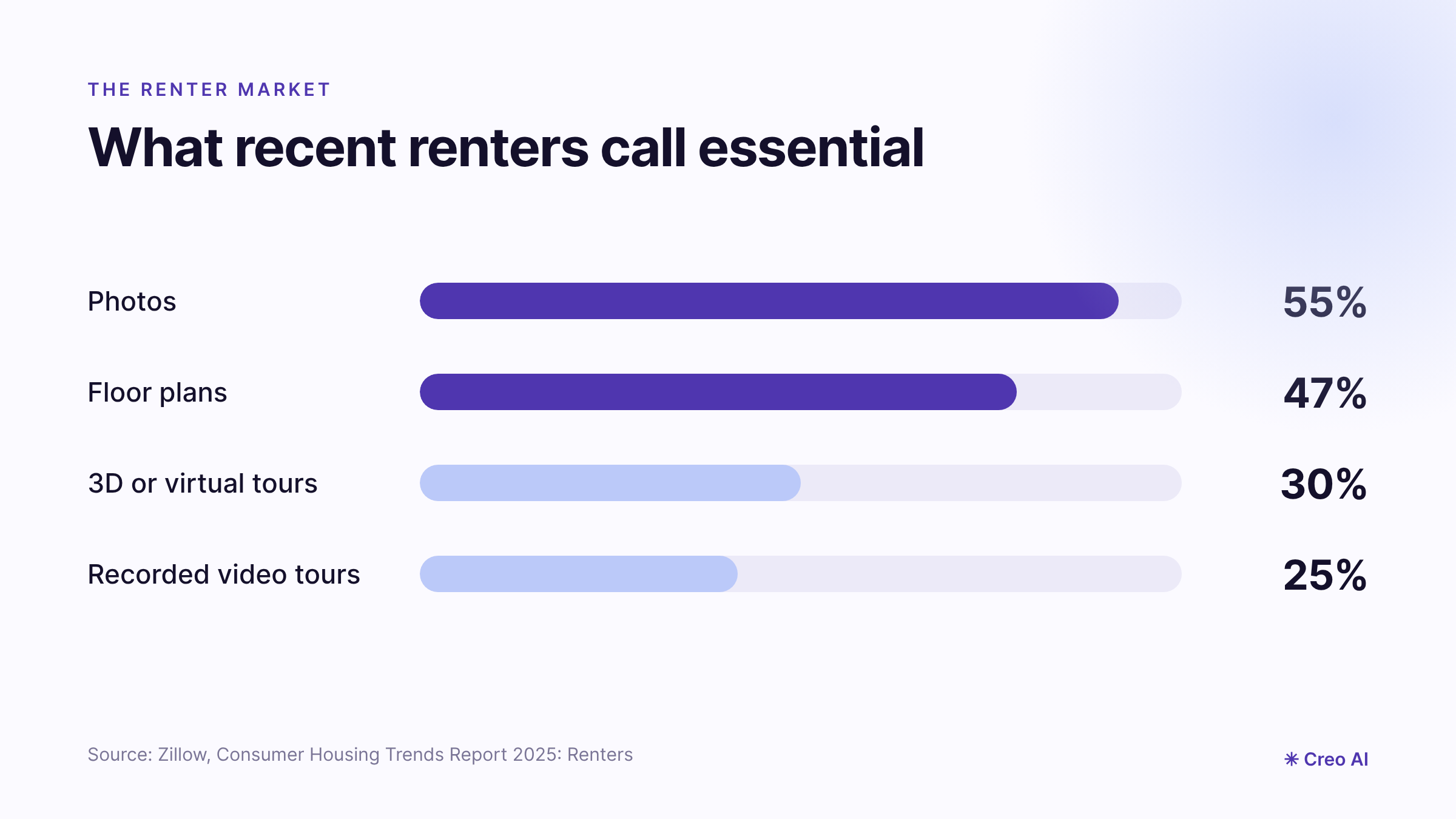
Renters search on phones, across several platforms, and they compare. Zillow's 2025 survey of more than 24,000 renters found that 81% of recent renters searched on a mobile website and 73% used a mobile app, that the median renter used five sites or apps, and that 77% submitted an application online (Zillow, 2025). Eighty-six percent said at least one digital feature was essential when choosing a home. Photos led at 55%, followed by floor plans at 47%, 3D or virtual tours at 30% and recorded video tours at 25%.
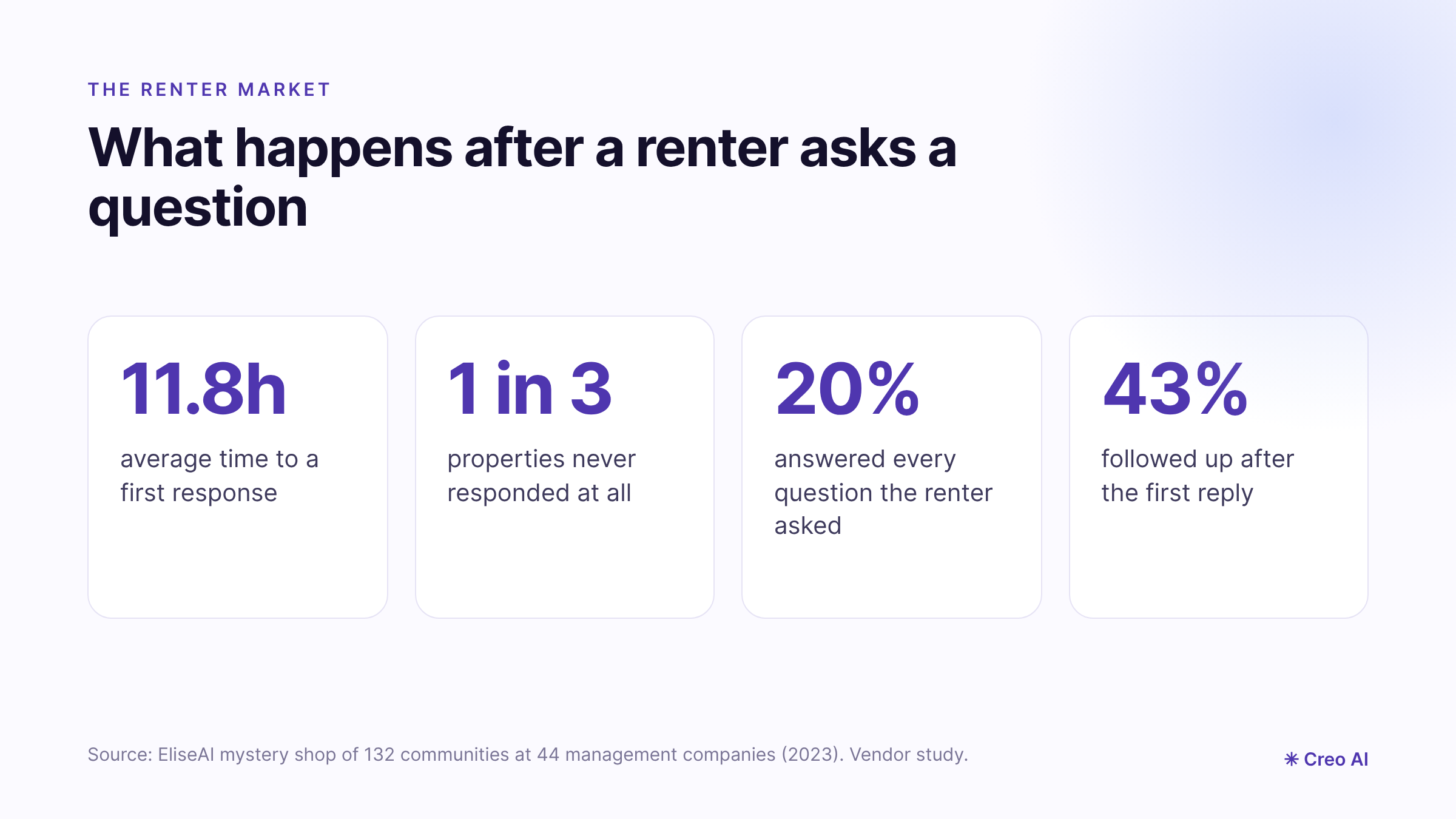
What happens after a renter asks a question is where many companies lose them. In a mystery shop of 132 communities run by 44 property management companies, the average response took 11.8 hours, one third of properties never responded, only 20% answered all four of the shopper's questions, and 43% followed up afterward (EliseAI, 2023). The study was published by a company that sells leasing automation, and it covers apartment communities rather than scattered single-family homes, so it is best read as a direction rather than a national rate. The direction matches older and broader research: across 2,241 U.S. companies, the average response to a web inquiry took 42 hours and 23% never responded at all (Oldroyd, McElheran and Elkington, 2011), and contacting a lead within five minutes rather than thirty made a company far more likely to reach and qualify the person (Oldroyd and InsideSales).
What a slow week costs
Vacancy has a simple price. At the national median asking rent of $1,541 a month, a vacant home loses about $51 in rent every day it sits (U.S. Census Bureau, 2026). Because most management fees are a share of rent collected, the manager loses its share of that too.
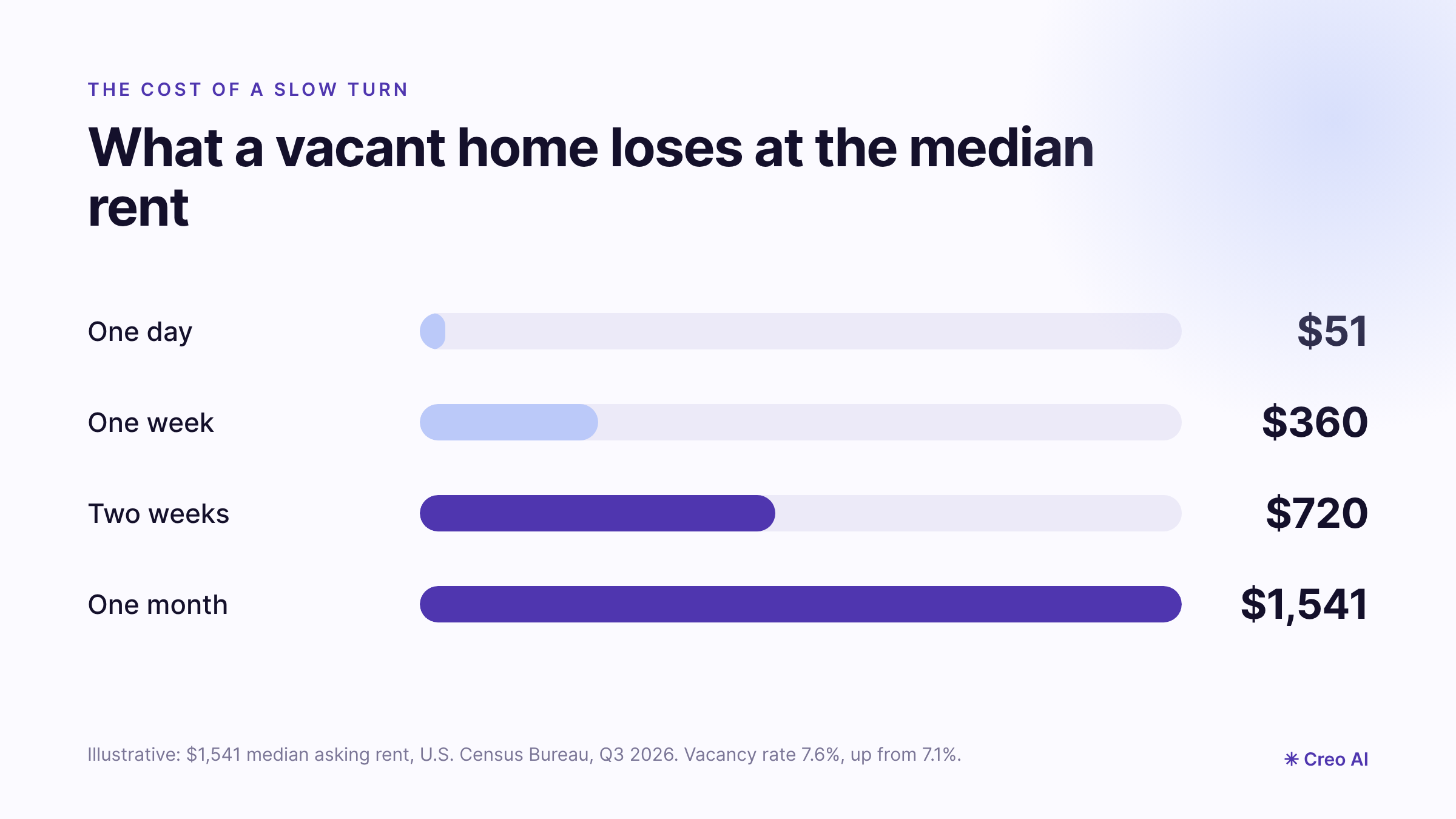
Illustrative arithmetic: the Census Bureau's median asking rent for vacant units in the third quarter of 2026, divided by 30 days. Local rents vary widely, and a manager should use its own.
Across a portfolio, the arithmetic compounds. A company that shortens every turn by a week saves each owner about a week of rent on each turn, and keeps its own fee on that week. That saving is usually larger than the marketing cost of achieving it, which is why the speed and quality of leasing follow-up belong in the same conversation as owner retention.
Where the stack breaks
Property management software has made the operational side of the business far more efficient: rent collection, maintenance requests, owner statements and screening. The marketing side usually lives elsewhere. A typical company keeps its website with one vendor, posts listings through syndication, runs ads with another provider, handles owner prospecting by referral and phone, and answers inquiries from whoever is free. Each piece can work. None of them shares what it learns with the others.
AI adoption has not closed that gap yet. Buildium found that 58% of property management companies used AI in 2025, up from 20% a year earlier, but only 8% had fully automated any process (Buildium, 2026). Most companies are using AI as a writing aid inside a fragmented stack, rather than as the thing that connects it.
The cost of the fragmentation shows up in exactly the places the data above points to: the owner who checks the website after a referral and finds it out of date, the renter who asks a question at 9 p.m. and hears back the next afternoon, and the owner who would consider leaving because they cannot see what their manager is doing for them.
What one system changes
Creo AI runs a property manager's marketing as one system, built around both markets. The property management software stays the system of record for operations. Creo runs the work around it.
For the owner market
- A website that answers owners. Clear pages on services, fees and every market the company serves, kept current and written to be found on Google and named by AI assistants.
- Owner content that shows expertise. Local rent and vacancy updates, regulatory changes and maintenance guidance, sent by email and posted on social, in the company's voice.
- Owner leads answered and followed. Every owner inquiry captured with its source, answered quickly, and followed up by the person who handles new business until the owner is ready to talk.
For the renter market
- Every available home, shown properly. Photos, floor plans, video and walkable 3D tours, the features renters say are essential.
- Ads for each property. Campaigns on Google and Meta that point to the home itself, run within the fair housing rules for housing ads.
- Replies in minutes, day or night. Inquiries answered quickly, with questions answered in full and showings offered, and a person on the team alerted when a renter is ready.
Across both
- One record. Every owner lead, renter inquiry, ad and email in one place, so the company can see which channels add doors and which fill them.
- A person approves. Creo drafts the pages, posts, emails and replies. Nothing goes out until someone at the company approves it.
Two sets of rules shape how this is done. Housing advertising is covered by the Fair Housing Act, which prohibits any advertisement that indicates a preference or limitation based on race, color, religion, sex, disability, familial status or national origin (42 U.S.C. §3604(c)). The major ad platforms enforce this for housing ads: Meta settled with the Justice Department in 2022 and removed targeting options for housing advertisers that relate to protected characteristics, and Google bars housing advertisers from targeting by age, gender, parental status, marital status or ZIP code (U.S. Department of Justice, 2022; Google, 2020). Creo's campaigns reach renters by the property and the renter's own actions, never by who the renter is. Text messages to renters and owners follow federal consent rules (47 CFR §64.1200).
What to measure
A system like this is worth only what it changes, so the measures should be set before it starts and compared with the company's own baseline.
| Measure | Why it matters |
|---|---|
| Time to first reply, owners and renters | The strongest early predictor of reaching the person at all |
| Owner leads per month, by source | Shows whether growth depends only on referrals |
| Doors added per quarter | The growth outcome owners of the company care about |
| Days vacant per turn | Converts directly into rent saved for owners |
| Inquiry to showing, showing to lease | Separates a traffic problem from a follow-up problem |
The takeaway
The data points in one direction. Owners judge a manager online, renters choose online, and in both markets the company that answers quickly and shows its work clearly has the advantage. Most property managers already own the tools to do that. What they lack is one system that runs those tools together and keeps both markets in view at once.
If you manage rental homes and want to see what that looks like for your portfolio, I would love to walk you through it. You can reach me at brayden@getcreo.ai.
Brayden Brezina, Business Lead, Growth and Commercialization, Creo AI
Sources
- AppFolio. "Owner Preferences Report 2026: Findings." November 2026. 1,009 U.S. residential rental owners with 1 to 25 units who use a professional manager. appfolio.com
- Buildium. "2026 Property Management Industry Report," and "How property managers plan to grow in 2026." buildium.com; buildium.com
- Buildium. "What do rental owners look for in a property management company?" 2024. buildium.com
- Congressional Research Service. "Ownership of the U.S. Rental Housing Stock" (R47332), December 2022, using the 2021 Rental Housing Finance Survey. everycrsreport.com
- EliseAI. "The 5 top insights from a nationwide mystery shop." January 2023. 132 communities, 44 property management companies. Published by a leasing automation vendor. eliseai.com
- Google Ads. "Update to Personalized advertising policies: Housing, employment, and credit." October 2020. support.google.com
- Oldroyd, J., McElheran, K., and Elkington, D. "The Short Life of Online Sales Leads." Harvard Business Review, March 2011. hbr.org. See also Oldroyd and InsideSales, Lead Response Management Study.
- Pew Research Center. "Google users are less likely to click on links when an AI summary appears in the results." July 2025. pewresearch.org
- U.S. Census Bureau. "Quarterly Residential Vacancies and Homeownership, Third Quarter 2026." October 28, 2026. census.gov
- U.S. Department of Justice. United States v. Meta Platforms, Inc. (S.D.N.Y.), settlement entered June 27, 2022. justice.gov
- Fair Housing Act, 42 U.S.C. §3604(c). law.cornell.edu
- Federal Communications Commission. Telephone Consumer Protection Act rules, 47 CFR §64.1200. ecfr.gov
- Zillow. "Consumer Housing Trends Report 2025: Renters." Surveys fielded March to July 2025, more than 24,400 renters. zillow.com
Figures checked November 2026. The vacancy-cost chart is illustrative arithmetic, not client data.
Ready to Transform Your Marketing?
See how Creo AI can help you save 15+ hours per week on marketing tasks.
Personalize my plan →